
Written by Prof. (Dr.) Shobhna Jeet
Abstract
The recall of the Supreme Court’s decision in Vanashakti v Union of India represents a significant moment in the evolution of Indian environmental jurisprudence. The original judgment struck down executive instruments permitting retrospective environmental clearances, reaffirming the mandatory nature of prior environmental approval under the Environmental Impact Assessment (EIA) regime. Its subsequent recall, justified on grounds of proportionality, economic impact, and overlooked precedent, reopens fundamental debates concerning precaution, non-regression, judicial review, and sustainable development. This article critically examines the recall through constitutional doctrine, comparative environmental principles, and the framework of the Sustainable Development Goals (SDGs). It argues that the decision introduces interpretive uncertainty into preventive environmental governance and raises structural concerns for institutional credibility and long-term sustainability compliance.
I. Introduction
Environmental governance in India has long evolved through judicial innovation. From the articulation of the precautionary principle to the recognition of environmental protection as integral to Article 21 of the Constitution, the Supreme Court has shaped the architecture of ecological constitutionalism. ¹ Within this trajectory, the 2025 decision in Vanashakti v Union of India appeared to consolidate a crucial doctrinal commitment: environmental clearance must precede project commencement. ²
The subsequent recall of that decision in November 2025, however, marks a notable recalibration. By invoking proportionality, economic consequences, and overlooked precedent, the Court reopened the permissibility of retrospective environmental clearance mechanisms introduced through executive notification.³
The recall raises pressing questions:
- Does proportionality dilute precaution in environmental law?
- What is the appropriate threshold for judicial review of landmark ecological rulings?
- How does this development align with India’s commitments under the Sustainable Development Goals (SDGs)?
- What are the long-term implications for regulatory certainty and institutional integrity?
This article addresses these questions in doctrinal and normative terms.
II. The EIA Framework and the Imperative of Prior Clearance
The Environmental Impact Assessment (EIA) Notification 1994 introduced mandatory prior environmental clearance for specified categories of projects.⁴ The 2006 EIA Notification strengthened this regime, expressly incorporating the term “prior” to emphasise temporal sequencing.⁵
The logic is preventive: ecological harm is often irreversible; therefore, scrutiny must precede intervention. This preventive orientation reflects the precautionary principle first explicitly endorsed by the Supreme Court in Vellore Citizens’ Welfare Forum v Union of India.⁶ There, the Court held that environmental measures must anticipate, prevent, and attack the causes of environmental degradation.⁷
Subsequent jurisprudence reinforced this approach. In Lafarge Umiam Mining (P) Ltd v Union of India, the Court stressed the importance of structured environmental decision-making and public participation.⁸ In Alembic Pharmaceuticals Ltd v Rohit Prajapati, the Court declared ex post facto environmental clearances “contrary to law” and “in derogation of the fundamental principles of environmental jurisprudence.”⁹
Against this background, the 2017 executive notification permitting retrospective environmental clearances represented a significant departure. It created a six-month window allowing projects that had commenced without prior clearance to seek post facto regularisation. A 2021 office memorandum further facilitated such regularisation.
The original Vanashakti judgment struck down both instruments, reaffirming that environmental clearance must precede project execution.¹⁰
III. The Original Vanashakti Judgment: Consolidating Precaution
The 2025 ruling reaffirmed three core principles:
- Mandatory Prior Clearance – Projects cannot lawfully commence absent environmental approval.
- Precautionary Principle – Risk assessment must precede harm.
- Deterrence of Non-Compliance – Retrospective regularisation rewards illegality.
The judgment relied upon Alembic Pharmaceuticals and earlier precedents to characterise ex post facto clearance as an “anathema” to environmental jurisprudence.¹¹
Importantly, the Court emphasised public participation. The EIA process includes public hearings and technical scrutiny. If projects are substantially complete before assessment, participatory governance becomes illusory.
The ruling thus aligned domestic doctrine with global sustainability frameworks, including SDG 13 (Climate Action), SDG 12 (Responsible Consumption and Production), and SDG 16 (Strong Institutions).
IV. The Recall: Proportionality and Public Interest
The recall decision rested on two principal grounds:
- Certain binding precedents had allegedly not been considered.
- The economic consequences of strict enforcement warranted reconsideration.
The majority opinion suggested that earlier rulings endorsed a “balanced approach” rather than categorical prohibition. It invoked proportionality and public interest, particularly where large infrastructure projects were involved.
Proportionality, a well-established constitutional doctrine, requires that state action not be excessive relative to legitimate objectives.¹² However, its transplantation into environmental sequencing raises doctrinal tension.
Environmental law is inherently anticipatory. Once harm occurs, proportional balancing may become structurally biased toward economic sunk costs. If developers complete substantial construction before clearance, demolition becomes politically and economically difficult. Proportionality thus risks privileging faits accomplish.
V. Precaution versus Proportionality: A Structural Tension
The precautionary principle requires preventive action even in the absence of full scientific certainty.¹³ It shifts the burden toward environmental protection.
Proportionality, by contrast, evaluates the reasonableness of state interference relative to competing interests. When applied post hoc, proportionality may attenuate precaution.
Consider a hypothetical: A large industrial facility commences operations without clearance. Once constructed, it employs thousands. Demolition may impose economic hardship. Under proportional reasoning, livelihood considerations may mitigate enforcement severity.
Yet such reasoning risks incentivising strategic non-compliance. Developers may internalise that violation can later be regularised upon showing economic significance.
The Supreme Court in Alembic Pharmaceuticals cautioned precisely against this dynamic.¹⁴ The recall potentially reintroduces flexibility where the Court had previously sought clarity.
VI. Sustainable Development and the SDG Framework
India adopted the Sustainable Development Goals in 2015.¹⁵ Sustainable development requires integration of economic growth, social equity, and environmental protection.
A. SDG 13 – Climate Action
Environmental clearances increasingly incorporate climate risk evaluation. Permitting post facto approvals undermines anticipatory integration of emissions, land-use change, and resilience planning.
B. SDG 12 – Responsible Consumption and Production
Responsible production demands compliance at the planning stage. Retrospective regularisation weakens compliance incentives.
C. SDG 15 – Life on Land
Biodiversity loss is often irreversible. Preventive clearance ensures ecological assessment precedes destruction.
D. SDG 16 – Strong Institutions
Perhaps most critically, SDG 16 emphasises effective, accountable institutions. Judicial stability and regulatory predictability are essential components of institutional credibility.
Frequent recall of landmark environmental decisions may erode confidence in the stability of environmental norms.
VII. Non-Regression and Progressive Environmental Protection
Comparative environmental law increasingly recognises the doctrine of non-regression, which prohibits weakening established environmental protections.¹⁶
While not formally codified in Indian law, the principle resonates with constitutional environmentalism. The original Vanashakti judgment strengthened precautionary sequencing. Its recall introduces ambiguity.
If environmental standards oscillate in response to economic pressures, progressive realisation of ecological rights may stall.
VIII. Judicial Review and Institutional Integrity
Review jurisdiction is narrow. It corrects patent error rather than reopens substantive debate.¹⁷ Expanding recall to reconsider interpretive balance may blur the distinction between review and rehearing.
Institutional legitimacy depends on consistency. Environmental governance, involving long-term ecological stakes, requires especially stable adjudication.
Moreover, executive incentives may shift. If retrospective approvals survive judicial scrutiny, regulatory enforcement may weaken.
IX. Developmental Realities and Governance Reform
The majority emphasised “ground realities” and regulatory fluidity. Developmental complexity is undeniable. However, institutional response must address systemic gaps rather than retroactively accommodate violations.
Regulatory clarity, administrative reform, and improved monitoring are preferable to post facto regularisation.
Sustainable infrastructure under SDG 9 requires environmental integration at inception—not adjustment after completion.
X. Conclusion
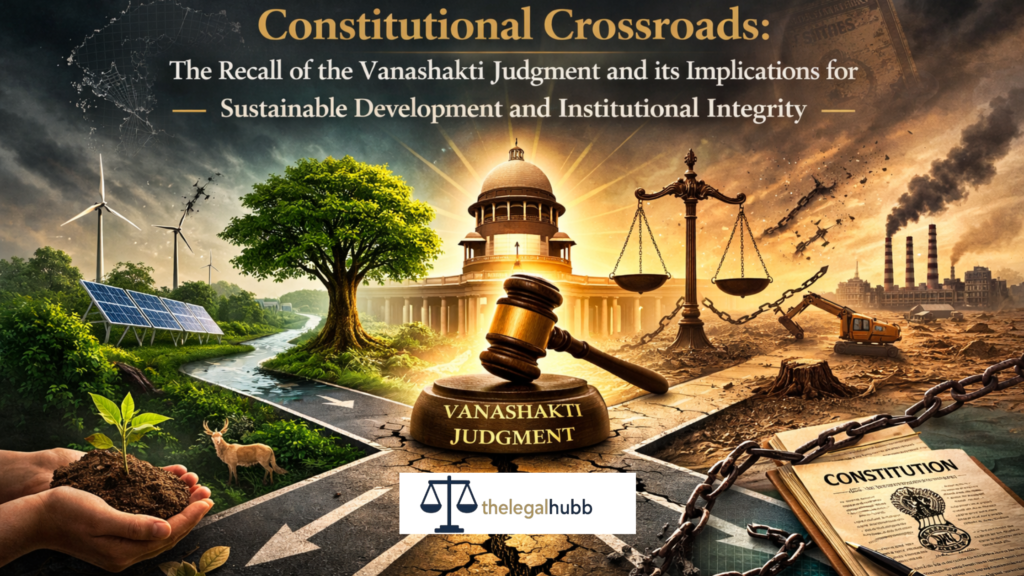
The recall of the Vanashakti judgment marks a constitutional crossroads. It reflects an attempt to reconcile economic proportionality with environmental discipline. Yet the risk lies in weakening the sequencing that anchors precaution.
For India’s SDG trajectory, three principles remain essential:
- Prevention over remediation
- Institutional consistency
- Meaningful public participation
Whether the recall becomes a narrow procedural correction or signals broader flexibility will depend on future interpretation.
In the era of climate urgency, environmental finality is not merely doctrinal—it is structural. Sustainable development requires that ecological safeguards remain foundational, not contingent.
Footnotes (OSCOLA)
- Subhash Kumar v State of Bihar (1991) 1 SCC 598.
- Vanashakti v Union of India (2025) Supreme Court of India.
- Review Order in Vanashakti v Union of India (18 November 2025).
- Environmental Impact Assessment Notification 1994, Ministry of Environment and Forests.
- Environmental Impact Assessment Notification 2006, Ministry of Environment and Forests.
- Vellore Citizens’ Welfare Forum v Union of India (1996) 5 SCC 647.
- ibid [11]–[13].
- Lafarge Umiam Mining (P) Ltd v Union of India (2011) 7 SCC 338.
- Alembic Pharmaceuticals Ltd v Rohit Prajapati (2020) 17 SCC 157.
- Vanashakti (n 2).
- Alembic Pharmaceuticals (n 9).
- Modern Dental College v State of Madhya Pradesh (2016) 7 SCC 353.
- A P Pollution Control Board v Prof MV Nayudu (1999) 2 SCC 718.
- Alembic Pharmaceuticals (n 9).
- United Nations General Assembly, ‘Transforming our World: The 2030 Agenda for Sustainable Development’ (21 October 2015) UN Doc A/RES/70/1.
- Michel Prieur, ‘The Principle of Non-Regression in Environmental Law’ (2012) 6 Sustainability 3856.
- Order XLVII, Code of Civil Procedure 1908.