Written by Prashant Panwar
The Supreme Court and the NCERT Textbook Controversy
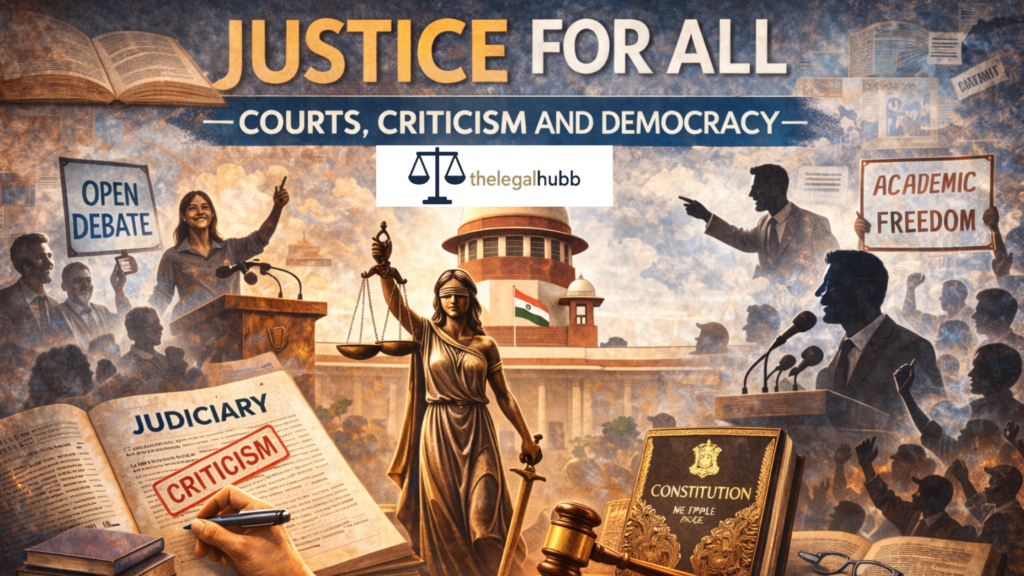
The phrase “justice for all” lies at the heart of constitutional democracy. Courts exist not merely to protect institutions but to ensure fairness, accountability and the rule of law for every citizen. Recently, however, a debate has emerged about whether the judiciary’s response to criticism in educational materials risks undermining that very principle.
The controversy began when the Supreme Court expressed strong objections to references to judicial corruption in a National Council of Educational Research and Training (NCERT) social science textbook. According to the Court, the textbook writers lacked “reasonable and informed knowledge about the Indian judiciary.” The Court further directed that individuals involved in preparing such material should not be associated with school curriculum development in the future.
This reaction has sparked an important discussion about the relationship between institutional respect, academic freedom and the broader idea of justice in a democratic society.
The Role of Educational Debate
School textbooks are not merely repositories of facts; they are instruments that shape critical thinking and civic understanding among students. When educational material discusses institutions like the judiciary, it is expected to explain both their achievements and their challenges.
Scholars argue that shielding institutions entirely from criticism may weaken the educational process. Students must learn how democratic institutions function, including debates about accountability and reform.
In fact, mature democracies encourage critical engagement with public institutions. This helps citizens develop trust based not on blind faith but on informed understanding.
The Risk of Selective Sensitivity
Critics of the Court’s reaction suggest that the response may appear disproportionate. The judiciary, like any other institution, operates within a constitutional framework that allows scrutiny and criticism.
The article suggests that if the Court insists on expert oversight for chapters concerning the judiciary, the same standard should apply to other areas of textbooks as well, including historical narratives where misinterpretation or bias may also occur.
Applying standards selectively could create the impression that the judiciary is attempting to shield itself from criticism rather than promoting balanced education.
Justice Beyond Institutional Prestige
The concept of justice extends beyond protecting the reputation of institutions. It involves ensuring that citizens can question authority, debate ideas and examine the functioning of public bodies.
Judicial independence is essential for democracy, but independence must coexist with openness to scrutiny. Public confidence in the judiciary grows not when criticism is suppressed but when institutions demonstrate transparency and accountability.
A judiciary that allows informed debate ultimately strengthens its legitimacy.
The Importance of Language and Intent
Another issue raised in the debate concerns how sensitive topics are presented in textbooks. Educational writing requires careful language and responsible interpretation. The goal should not be sensationalism but balanced discussion that encourages inquiry.
Students should learn to appreciate values such as fairness, equality, peace and constitutional morality. Textbooks should therefore present issues in ways that stimulate thoughtful discussion rather than polarised judgments.
The emphasis must remain on cultivating informed citizens rather than defending institutional prestige.
The Larger Democratic Principle
The controversy highlights a broader question: what does “justice for all” truly mean in a constitutional democracy?
Justice requires protecting institutions, but it also requires protecting academic freedom, public debate and the right to question authority. Democracies thrive when institutions are strong enough to withstand criticism and confident enough to engage with it.
If criticism is viewed solely as an attack rather than as an opportunity for reflection, the democratic space for dialogue may shrink.
Conclusion
The debate surrounding the NCERT textbook illustrates the delicate balance between institutional dignity and intellectual freedom. While the judiciary rightly seeks to protect its credibility, it must also uphold the broader democratic values that allow open discussion about public institutions.
Ultimately, justice for all means more than defending authority. It means creating a society where institutions remain accountable, citizens remain informed and dialogue remains open.
In a democracy, justice is not merely delivered in courtrooms; it is sustained through transparency, debate and the freedom to question power.