The Idea Behind One Nation, One Election
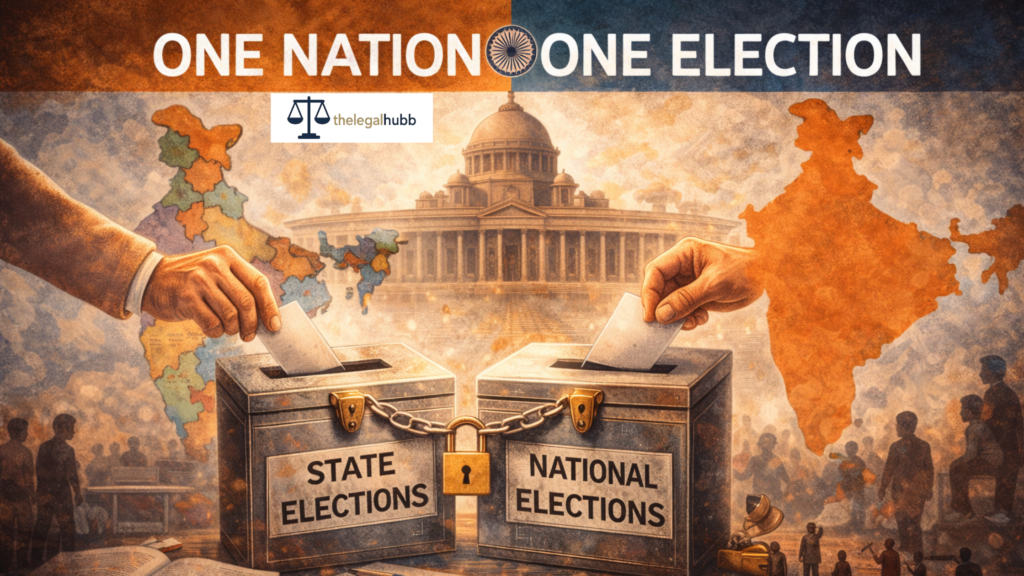
The proposal of “One Nation, One Election” (ONOE) refers to the idea of conducting elections for the Lok Sabha and all State Legislative Assemblies simultaneously instead of the current system where elections occur at different times across the country. The objective is to synchronise electoral cycles so that national and state elections take place together once every five years.
Supporters of the proposal argue that frequent elections disrupt governance, impose significant financial costs and keep political parties in constant campaign mode. By synchronising elections, they believe the country can reduce expenditure, improve policy continuity and minimise administrative disruptions caused by the Model Code of Conduct.
However, critics warn that such a reform could have serious implications for India’s federal structure and democratic functioning.
Constitutional Framework and Proposed Changes
A key institutional effort to advance the ONOE proposal was the formation of a High-Level Committee chaired by former President Ram Nath Kovind in 2023–24. The committee’s recommendations have taken legislative shape through the Constitution (One Hundred and Twenty-Ninth Amendment) Bill, 2024.
The proposal introduces Article 82A, which would allow the President to notify an “appointed date” from which the tenure of all State Assemblies would align with the Lok Sabha election cycle. Assemblies formed after this date may have their tenure shortened to achieve synchronisation.
Another provision introduces the concept of “unexpired-term elections.” If a legislature is dissolved prematurely, the newly elected body would serve only the remaining portion of the original five-year term instead of receiving a full term. 9 March
These proposed changes mark a significant restructuring of India’s electoral system.
The Case in Favour of Simultaneous Elections
Supporters of ONOE highlight several advantages. First, simultaneous elections could substantially reduce public expenditure. Elections in India require large deployments of security personnel, election officials and administrative machinery. Conducting these processes together could streamline resources.
Second, synchronised elections could reduce the frequency of the Model Code of Conduct, which temporarily restricts government policy decisions during election periods. Frequent enforcement of the code often slows development projects and administrative initiatives.
Third, proponents argue that simultaneous elections would allow governments to focus more on governance rather than continuous campaigning. Political parties often shift attention toward electoral mobilisation rather than policymaking when elections occur every few months in different states.
These arguments present ONOE as a reform aimed at improving governance efficiency.
Lessons from International Experiences
Comparative constitutional practice offers mixed lessons regarding synchronised elections. Countries such as Canada and Australia conduct national and regional elections independently. In these systems, provincial or state legislatures operate on their own electoral schedules.
Germany provides another instructive example. Its political stability does not arise from synchronised elections but from institutional mechanisms like the constructive vote of no confidence, which ensures that a new government must be elected before the existing one is removed.
Indonesia experimented with large-scale simultaneous elections in 2019. While intended to simplify the electoral process, the exercise led to severe administrative stress. Nearly 900 poll workers died and thousands fell ill due to the enormous logistical burden. In response, Indonesia’s Constitutional Court later ruled that national and local elections should again be separated from 2029 onward. 9 March
These experiences highlight the complexity of implementing large-scale electoral synchronisation.
Federalism and Democratic Concerns
One of the most significant concerns surrounding ONOE relates to India’s federal structure. The Constitution recognises states as autonomous political entities with their own democratic rhythms. State elections occurring at different times allow voters to evaluate state governments independently of national political trends.
Synchronised elections may weaken this distinction. A strong national political wave could overshadow regional issues and influence state elections disproportionately.
The Supreme Court has emphasised the importance of federalism in several judgments. In S.R. Bommai v. Union of India (1994), the Court recognised federalism as part of the Constitution’s basic structure. States are not merely administrative units but constitutionally autonomous governments with their own democratic mandates.
Therefore, altering electoral cycles across states raises important constitutional questions.
Governance Risks and Institutional Power
Another concern arises from the possibility of political misuse. If a state government collapses before completing its tenure, synchronisation rules may allow the Union government to impose President’s Rule and delay elections until the next common electoral cycle.
Such provisions could potentially allow central authorities to influence state governance. Even if such misuse is unlikely, the mere possibility raises concerns about democratic safeguards.
Constitutional scholars often emphasise that institutional design must minimise opportunities for misuse of power.
Conclusion
The proposal of One Nation, One Election represents one of the most significant electoral reforms debated in recent years. While it promises potential benefits such as reduced costs, administrative efficiency and greater policy continuity, it also raises serious concerns regarding federalism, democratic accountability and constitutional balance.
India’s democratic structure is complex and deeply pluralistic. Electoral diversity across states reflects the federal character of the Constitution. Any attempt to restructure this system must therefore carefully weigh efficiency against constitutional values.
Ultimately, the debate over ONOE is not merely about election scheduling. It is about how India chooses to balance governance efficiency with the principles of federal democracy.