Written by Prashant Panwar
Life, Dignity and the Constitution
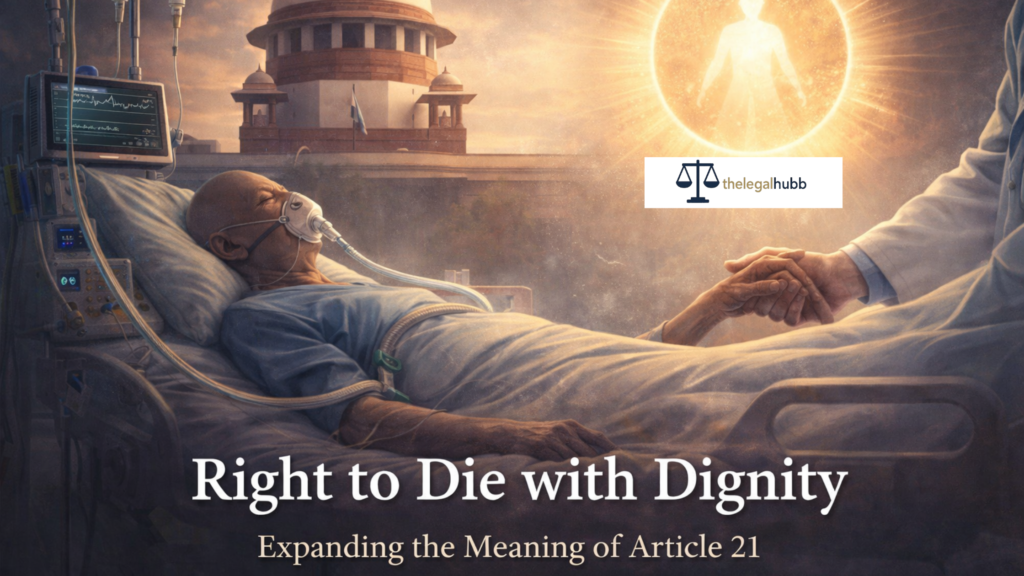
The Constitution of India guarantees the right to life under Article 21, but over the years, the Supreme Court has interpreted this right far beyond mere survival. It now includes the right to live with dignity, autonomy and meaningful existence.
A profound question arises from this expanded understanding: does the right to live with dignity also include the right to die with dignity?
This question has been at the centre of constitutional and ethical debates, particularly in cases involving terminal illness, prolonged suffering and life-support systems.
The Judicial Journey: From Denial to Recognition
The Supreme Court’s approach to this issue has evolved significantly over time.
In Gian Kaur v. State of Punjab (1996), the Court held that Article 21 guarantees the right to live with dignity but does not include the right to die. Suicide and its abetment were therefore not constitutionally protected.
However, the Court left open a crucial possibility — that in certain circumstances, particularly involving terminal illness, the idea of dignity at the end of life might require a different interpretation.
This possibility later shaped a transformative shift in constitutional jurisprudence.
The Landmark Turning Point
The real breakthrough came in Common Cause v. Union of India (2018). In this landmark judgment, a Constitution Bench of the Supreme Court recognised that the right to die with dignity is an integral part of Article 21.
The Court allowed individuals to refuse medical treatment and recognised the legality of passive euthanasia, which involves the withdrawal or withholding of life-sustaining treatment under specific safeguards.
The judgment also introduced the concept of a “living will” or advance directive, allowing individuals to express their wishes regarding medical treatment in situations where they may not be able to communicate their decisions.
This marked a shift from viewing life as mere biological existence to recognising autonomy and dignity as essential components of life itself.
The Recent Development
The issue recently came into focus again in a case involving a patient on life support. The Supreme Court permitted the withdrawal of life-sustaining treatment, following the guidelines laid down in the Common Cause judgment.
This decision reaffirmed that the right to die with dignity is not theoretical but enforceable in real-life situations. It also highlighted the role of courts in ensuring that medical decisions respect both legal safeguards and human dignity.
Ethical and Legal Dimensions
The recognition of the right to die with dignity raises complex ethical questions. On one hand, it protects individuals from prolonged suffering and respects their autonomy. On the other hand, it raises concerns about misuse, coercion and the sanctity of life.
The law attempts to strike a balance by permitting only passive euthanasia under strict procedural safeguards, including medical opinion and judicial oversight.
Active euthanasia, where life is deliberately ended through medical intervention, remains illegal in India.
Dignity at the End of Life
At its core, the debate is not about ending life but about ending suffering in a dignified manner. Modern medicine can prolong life, but it cannot always ensure quality of life.
The Constitution’s promise of dignity must therefore extend to the final stages of life. For patients in irreversible medical conditions, dignity may mean the ability to refuse invasive treatment and allow a natural death.
This perspective shifts the focus from preserving life at all costs to preserving the quality and dignity of life.
Conclusion
The recognition of the right to die with dignity represents a significant evolution in Indian constitutional law. It reflects a humane understanding of life, autonomy and suffering.
Article 21 is no longer confined to the protection of physical existence. It now encompasses the right to make deeply personal choices about one’s life and, in certain circumstances, one’s death.
In recognising this right, the Supreme Court has reaffirmed a fundamental principle: dignity must accompany life — and remain intact even at its end.