
Written by Prashant Panwar
The Constitutional Shield of Debate
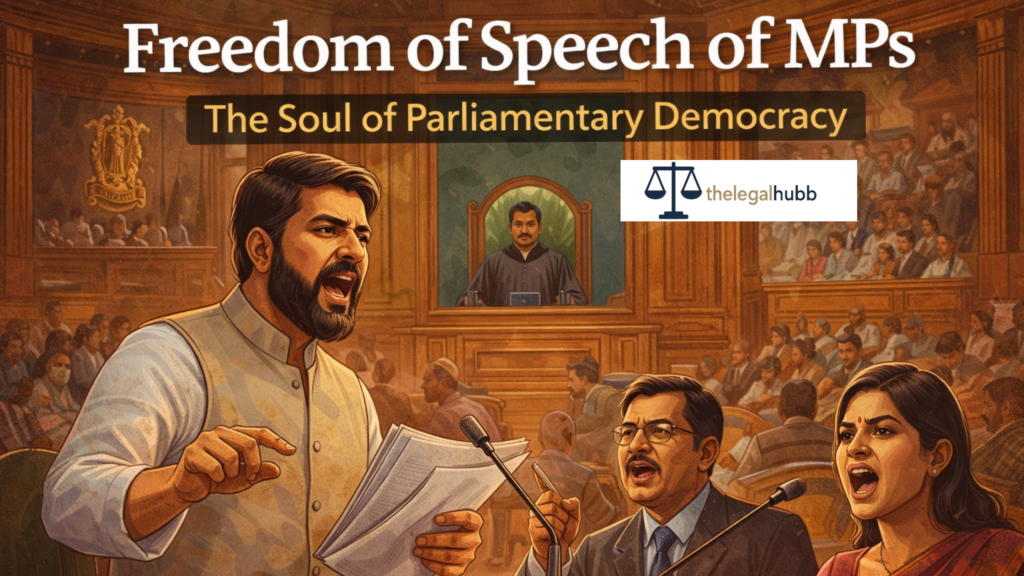
Parliament is not merely a law-making body; it is the arena where the nation argues with itself. It is the space where dissent meets authority, where opposition confronts government, and where public grievances are transformed into legislative discourse. At the heart of this democratic theatre lies one indispensable principle — the freedom of speech of Members of Parliament.
The Constitution of India recognises this freedom as a parliamentary privilege under Article 105. It grants Members of Parliament the right to speak freely in the House without fear of legal consequences for what they say within its walls. This protection is not ornamental. It is functional. It exists to ensure that representatives of the people can articulate concerns, criticise policies and hold the executive accountable without intimidation.
Without this freedom, Parliament would be reduced to ritual rather than deliberation.
Article 105 and the Architecture of Privilege
Article 105 provides that Members of Parliament shall have freedom of speech in Parliament and shall not be liable to any proceedings in any court in respect of anything said or any vote given in Parliament. This immunity is absolute within the parliamentary context. It shields MPs from defamation suits, criminal prosecution or civil liability arising out of speeches delivered in the House.
This constitutional privilege recognises that legislative debate must be fearless. Representatives cannot perform their duties effectively if they must constantly worry about litigation or executive retaliation.
However, this freedom is not anarchic. It operates within the framework of parliamentary rules. The Constitution allows each House to regulate its own procedure. The Speaker or Chairman retains the authority to maintain decorum and discipline.
The tension between constitutional privilege and procedural control often defines the boundaries of this freedom.
Expunction and the Limits of Control
Parliamentary rules permit the presiding officer to expunge words that are unparliamentary, defamatory, indecent or undignified. Such power exists to preserve institutional dignity and ensure civil discourse. However, the power of expunction is meant to be precise, not sweeping.
If applied excessively or mechanically, it risks diluting the constitutional privilege itself. Removing entire arguments or substantial portions of speech may amount to indirectly restricting what Article 105 seeks to protect.
The right of an MP to have their speech recorded in official proceedings is central to parliamentary accountability. If significant portions are deleted without transparent reasoning, the democratic record becomes incomplete.
Thus, the issue is not whether discipline should exist — it must — but whether it is exercised proportionately and judiciously.
The Importance of Opposition Speech
A democracy cannot function without an effective opposition. The freedom of speech of MPs is particularly crucial for opposition members, whose primary role is to question, scrutinise and critique the government.
The constitutional design assumes adversarial debate. Government policies are tested through disagreement. When opposition voices are constrained, the deliberative character of Parliament weakens.
History demonstrates that robust legislative debate has improved laws, exposed executive excesses and reflected public anxieties. Silencing dissent within Parliament undermines not only individual MPs but the electorate they represent.
Freedom of speech in Parliament is therefore not a privilege for individuals; it is a safeguard for citizens.
Parliamentary Decorum and Constitutional Responsibility
While constitutional protection is broad, parliamentary speech is not entirely unregulated. Article 121 prohibits discussion in Parliament regarding the conduct of judges of the Supreme Court or High Courts except in the context of removal motions. This limitation preserves judicial independence.
Similarly, rules of procedure maintain order and prevent abuse of speech. Parliamentary language must remain respectful and focused on substantive debate.
The challenge lies in maintaining a balance between discipline and democracy. Excessive permissiveness can erode institutional dignity. Excessive restriction can erode democratic vitality.
The presiding officer occupies a position of immense constitutional responsibility. Neutrality, fairness and restraint in applying procedural rules are essential to preserving trust.
The Larger Democratic Context
In recent years, debates around suspension of members, expunction of remarks and restrictions on speech have raised questions about the health of parliamentary discourse. When interruptions replace arguments, or procedural tools are used to curtail extended debate, the spirit of deliberative democracy weakens.
Parliament is not designed to be comfortable. It is designed to be argumentative. The framers of the Constitution understood that democracy thrives on contestation. Silence is not a sign of harmony; often it signals suppression.
If Members feel that their speech may be curtailed unpredictably, self-censorship may follow. That, in effect, creates a chilling effect within the legislature itself.
Why Parliamentary Speech Matters Beyond the House
Freedom of speech in Parliament does not end at the chamber door. Parliamentary proceedings shape public discourse. They influence media narratives, policy debates and civic engagement. When debate is vibrant, public understanding deepens.
Conversely, when speech is restricted or reduced to slogan exchanges, citizens lose confidence in parliamentary relevance. Transparency of debate is essential to democratic legitimacy.
Parliament is the highest deliberative forum in the country. Its vitality determines the tone of democratic culture across institutions.
Conclusion: Protecting the Deliberative Core
Freedom of speech of MPs is not a courtesy extended by the majority; it is a constitutional guarantee. It exists so that the Legislature can perform its core function — deliberation without fear.
Balancing decorum with dissent is not easy. But constitutional democracy demands that the scales tilt in favour of open debate. The dignity of Parliament lies not in suppressing uncomfortable voices, but in accommodating them within structured argument.
When MPs speak freely, democracy breathes. When their speech is constrained beyond necessity, democracy constricts.
The strength of a Parliament is measured not by the volume of agreement, but by the depth of its debate.